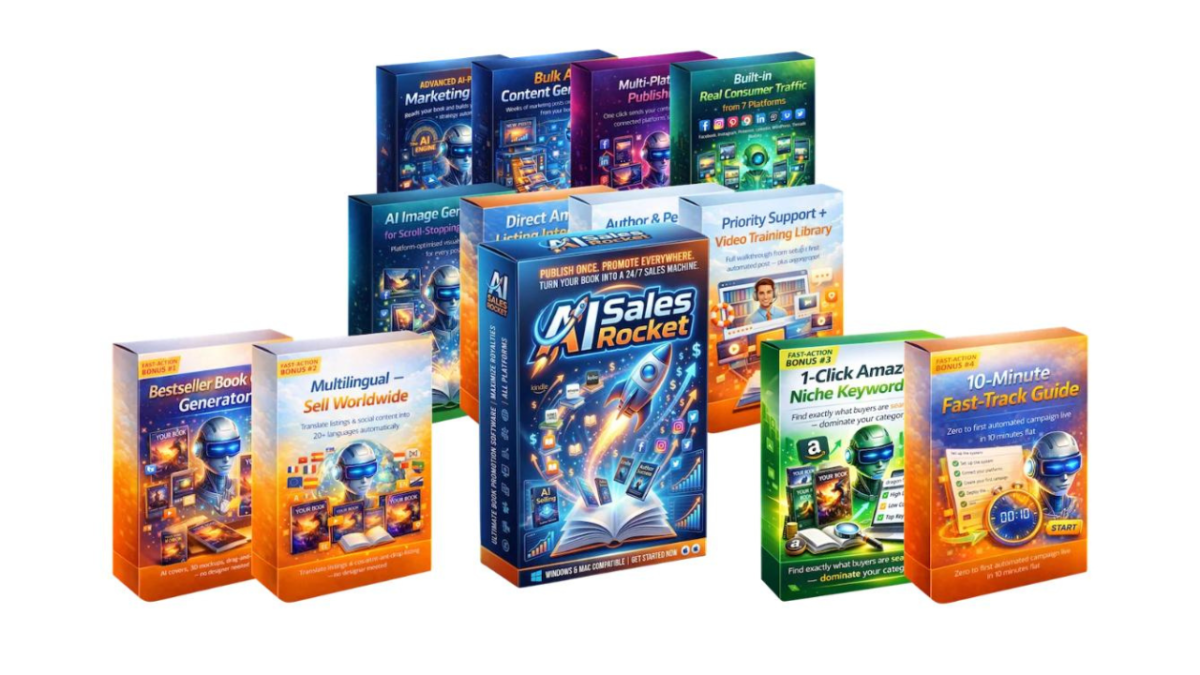
The Honest Truth Every Self-Publisher Needs to Read AI Sales Rocket Review 2026 explores how this AI-powered marketing tool helps Amazon KDP authors automate book promotion and improve visibility online.
You spent months writing your book. You formatted it perfectly, designed a great cover, and finally hit Publish on Amazon KDP.
No sales. No traffic. No reviews. Just a flat dashboard staring back at you.
If this sounds familiar, you are not alone. Thousands of self-published authors face this exact problem every single day. The issue is never the writing — it is the lack of visibility in an ocean of millions of books.AI Sales Rocket Review
That is exactly why AI Sales Rocket was created. And in this honest review, I am going to break down everything you need to know before you decide.
AI Sales Rocket is a cloud-based book marketing automation platform built specifically for Amazon KDP authors and self-publishers.
It is not a generic social media scheduler. It is not a random AI writing tool. It was designed from the ground up with one mission — get your books in front of more readers automatically.
The core promise is simple:AI Sales Rocket Review
“Upload Once. Generate Everything. Post Everywhere.”
You upload your book manuscript, connect your social media accounts, and the AI handles all the marketing — 24 hours a day, 7 days a week — without you writing a single post manually.
How Does AI Sales Rocket Work? AI Sales Rocket Review
The process is incredibly beginner-friendly:
Step 1 — Upload Your Book Upload your manuscript in PDF, DOC, or EPUB format directly into the platform.AI Sales Rocket Review
Step 2 — AI Reads and Generates The AI scans your entire book and creates marketing content written in your book’s own voice and style — not generic filler content.
Step 3 — Connect Your Platforms Link your social media accounts to the dashboard in just a few clicks.
Step 4 — Sit Back and Let Autopilot Run The platform automatically publishes promotional content across multiple platforms around the clock — driving consistent traffic back to your Amazon listing.
Which Platforms Does It Support?
Once connected, AI Sales Rocket posts your book promotions across 7 major platforms:
📘 Facebook
📸 Instagram
📌 Pinterest
💼 LinkedIn
🌐 WordPress Blog
🧵 Threads
🦋 Bluesky
That is 7 platforms running simultaneously — without you doing any extra work.
Key Features of AI Sales Rocket
AI Content Generation The tool reads your actual manuscript and creates posts specific to your book — not the lazy “available now on Amazon!” filler you would get from a basic prompt.
Automated Multi-Platform Posting Schedule and publish weeks of content across all connected platforms in one click. Amazon KDP
AI-Generated Marketing Images Eye-catching promotional visuals created automatically — no Canva skills needed.AI Sales Rocket Review
AI Funnel Builder Build landing pages, sales pages, and lead capture pages to collect reader emails and grow your audience.
Email Sequence Creator Automated email follow-ups that keep readers engaged and drive repeat purchases.
Amazon Listing Integration All traffic is directed straight to your Amazon KDP book listing for maximum conversions.
Book Blurb Engine(Free Bonus) Instantly generate compelling book descriptions that make readers click Buy Now.AI Sales Rocket Review
The front-end price of just $17 is a one-time payment — no monthly fees, no subscriptions.
A 14-Day Money Back Guarantee is included, which means your investment carries absolutely zero risk.
Who is AI Sales Rocket Best For?
✅ Amazon KDP authors struggling with zero visibility ✅ Self-publishers who want passive income from their books ✅ Busy authors who have no time for daily social media ✅ Complete beginners who know nothing about marketing ✅ Authors writing in any language or niche ✅ Anyone who wants to promote multiple books at once AI Sales Rocket Review
What I Like About AI Sales Rocket 👍
Extremely affordable at just $17
Built specifically for KDP — not a generic tool
Posts in your book’s actual voice, not generic content
Covers 7 major platforms simultaneously
Zero technical skills required
14-day money back guarantee removes all risk
Saves hours of daily manual work
What Could Be Better 👎
You need to bring your own OpenAI or Claude API key
Low monthly search volume means it is a new product
Does AI Sales Rocket really work? Yes — the platform automates genuine content creation from your actual manuscript, which is far more effective than generic posts. Consistent daily posting across 7 platforms significantly increases visibility over time.
Is AI Sales Rocket worth buying? At $17 with a money-back guarantee, the risk is almost zero. If you are a KDP author struggling with visibility, it is absolutely worth trying.
How long does setup take? Most users complete the full setup in under 10 minutes.
Do I need any technical skills? No. The platform is beginner-friendly and designed for authors, not tech experts.
Is there a monthly fee? No. The front-end purchase is a one-time payment only.
What happens if it does not work for me? You are covered by a 14-day money back guarantee — no questions asked.AI Sales Rocket Review
My Final Verdict AI Sales Rocket Review
AI Sales Rocket solves the single biggest problem every KDP author faces — consistent daily visibility without spending hours on marketing.
For $17, you get a dedicated AI marketing engine that reads your book, creates content in your voice, and promotes it across 7 platforms automatically. While you focus on writing your next book, AI Sales Rocket keeps your existing books in front of new readers every single day.
The combination of low price, zero monthly fees, beginner-friendly setup, and a money-back guarantee makes this a no-brainer investment for any serious KDP author.
14-Day Money Back Guarantee | One-Time Payment | Instant Access
Disclosure: This article contains affiliate links. If you purchase through my link, I may earn a small commission at no additional cost to you. I only recommend tools I genuinely believe will help authors succeed.AI Sales Rocket Review
Finding profitable traffic sources for affiliate marketing doesn’t require a massive advertising budget. In fact, 70% of affiliate marketers consider SEO their most effective traffic strategy, but it’s only one of many free channels available. The landscape has expanded significantly, with platforms like TikTok reaching over 1 billion monthly active users and video content in affiliate marketing growing 22% in 2023 alone. If you follow the right free traffic for affiliate marketing methods, you can build long-term passive income online. According to HubSpot, SEO is one of the best ways to generate free traffic for affiliate marketing. To get better results, also explore the best affiliate tools for beginners.
Table of Contents
Learning how to get free traffic for affiliate marketing is essential when you’re working with limited resources or testing new offers. The best free traffic sources for affiliate marketing in 2026 offer sustainable growth without ongoing ad spend. In this guide, we’ll explore proven affiliate marketing traffic sources that cost nothing and show you how to leverage free traffic for affiliate marketing success across multiple platforms. free traffic for affiliate marketing strategies Free traffic for affiliate marketing is one of the best ways to start earning online without spending money.
At first glance, the comparison appears straightforward: paid traffic delivers immediate results but demands continuous investment, while organic traffic requires minimal financial outlay but significant time and effort. The fundamental difference lies in sustainability. When advertising budgets are reduced or paused, paid traffic disappears instantly. Organic traffic, in contrast, continues to deliver value regardless of short-term budget changes, providing stability during economic shifts. These free traffic for affiliate marketing strategies can help beginners generate consistent traffic without spending money.
The financial risk factor matters considerably for beginners. Many affiliate campaigns fail, so investing heavily in paid ads without guaranteed returns can drain resources quickly. Free traffic sources for affiliate marketing eliminate this downside while allowing you to test offers and refine your approach.
Long-Term Benefits of Organic Traffic
Organic content creates compounding value that paid advertising cannot match. A well-optimized page can attract visitors for months or even years without additional cost. Each piece of organic content contributes to a growing digital asset. As content gains authority and trust, it ranks for multiple related queries, increasing reach without proportional increases in cost. These free traffic for affiliate marketing strategies can help beginners generate consistent traffic without spending money.
This cumulative effect separates successful long-term marketers from those chasing quick wins. Your old blog posts, videos, and social media content continue working in the background, surfacing through algorithms and earning commissions long after creation. best free traffic for affiliate marketing beginners
Organic visitors arrive with stronger purchase intent than passive audiences reached through ads. Because they land on your content through relevant queries, they’re already motivated to act and further along in the decision process. This translates to higher conversion rates on landing pages that align with search intent. If you follow the right free traffic for affiliate marketing methods, you can build long-term passive income online.
Building Sustainable Affiliate Income
Building through organic methods establishes credibility and positions you as a reliable authority in your niche. Recurring visitors who seek reliable information are more likely to subscribe to email lists, follow social accounts, or recommend your content. Over time, this credibility attracts valuable backlinks from other sites, further boosting rankings. According to HubSpot, SEO is one of the best ways to generate free traffic for affiliate marketing.
The effort you invest in building organic content also protects you from competitors who want to copy your success. While anyone can replicate paid ad copy, a successful website or YouTube channel built over time cannot be duplicated overnight. These free traffic for affiliate marketing strategies can help beginners generate consistent traffic without spending money.
Google now prioritizes Reddit content in search results, making it one of the fastest-rising platforms for affiliate traffic. With communities organized into topic-specific subreddits, you can target exactly the audiences interested in your offers. The platform rewards authentic participation. Build karma by making 90% of your posts informative and advice-driven. Get to know subreddit moderators and ask permission before sharing affiliate recommendations. Due to Reddit’s reputation-based system, established accounts with high karma receive more visibility and trust from community members. According to HubSpot, SEO is one of the best ways to generate free traffic for affiliate marketing.
YouTube and YouTube Shorts
As the second-largest search engine worldwide, YouTube offers unmatched discoverability for affiliate content. Long-form videos allow deeper engagement and trust-building, while viewers arrive with intent to learn or solve problems. YouTube Shorts provides an additional advantage: the algorithm favors this format heavily, pushing content to broader audiences even with zero subscribers. This means you can start earning affiliate commissions without needing an existing following.
Medium for Long-Form Content
Medium ranks among the top 300 most visited websites globally and allows affiliate links when properly disclosed. Articles perform well on Google searches due to Medium’s domain authority. The platform’s curation system rewards high editorial standards and reader-focused content. Particularly effective for detailed product reviews and thought leadership pieces that attract highly targeted leads. how to get free traffic for affiliate marketing
Pinterest for Evergreen Visual Traffic
Pinterest reaches 570 million monthly active users, with 80% using the platform with shopping intent. Unlike social media where posts vanish quickly, Pinterest content maintains an average lifespan of 3.5 months. As a visual search engine, well-optimized pins can drive traffic for months or years after posting. The platform doesn’t require large followings to succeed.
Quora for Intent-Based Answers
Quora attracts over 300 million monthly users, with 71.04% of traffic coming from organic searches. People ask detailed, specific questions, giving you direct access to audiences actively seeking solutions. While direct affiliate links aren’t allowed, you can redirect users to landing pages or blog posts containing your offers. Answers often rank on Google, extending reach beyond the platform itself.
TikTok Organic Reach
With over 1 billion monthly active users, TikTok’s algorithm pushes content organically without limiting reach based on follower count. The platform doesn’t restrict video visibility, meaning creative content can appear before billions of potential customers. Place affiliate links in your bio and direct viewers there through engaging short-form videos.
Value-first marketing prioritizes supporting your audience before selling to them. Your orientation shifts from convincing people to buy toward genuinely helping them solve problems. Content should feel relatable, engaging, and authentic to build trust and drive conversions. Share honest assessments including both strengths and limitations of products, as readers value transparency over sales pitches. Each piece needs to deliver genuine value while naturally incorporating affiliate recommendations.
Use Platform-Specific Strategies
Adapting content to each channel seems like extra work, but you don’t need to start from scratch with each campaign. Repurpose high-performing content by making adjustments suited to each platform’s audience and algorithm. Pull out the strongest affiliate hook or key benefit from longer content and present it in that platform’s most engaging native format. Use relevant keywords on social media to stay visible in search trends, as social algorithms run off SEO principles just like Google.
Track and Optimize Your Results
Without accurate tracking, you’re just guessing and could miss opportunities to convert new customers. Monitor click-through rates, conversion rates, and which posts generate the most revenue. Track buying behavior to identify patterns or popular product categories, then analyze the data monthly and double down on top-performing items. This data-led approach reveals what’s working and what isn’t.
Build an Audience Over Time
Affiliate marketing is a journey, not a sprint. Getting the right audience and converting them to the right offers takes time, and you’ll only get it right through trials and testing. Building through organic methods establishes credibility and positions you as a reliable authority. Focus on creating content that helps, educates, and builds trust rather than just promoting links.
Common Mistakes to Avoid with Free Affiliate Marketing Traffic Sources
Spamming Links Without Context
Flooding social media feeds or inboxes with unsolicited affiliate links destroys trust faster than any other mistake. People block you immediately when they sense you’re chasing commissions rather than providing value. Spamming gets your content flagged or removed from platforms, and group administrators will ban you for copy-pasting promotions across multiple communities.
Owing to laws like the CAN-SPAM Act, violations can result in hefty fines and legal penalties. Share affiliate links only after establishing context through helpful content that addresses real problems.
Ignoring Platform Rules and Guidelines
Each platform maintains strict policies about affiliate marketing. Breaking these rules leads to account suspensions and lost revenue. The FTC requires clear disclosure of affiliate relationships. Your endorsement message should make it obvious when you have a material connection with brands. Hiding affiliations is illegal in many countries and breaks FTC rules. Place disclosures where they’re hard to miss, not buried in profile pages or after “read more” buttons. According to HubSpot, SEO is one of the best ways to generate free traffic for affiliate marketing.
Not Diversifying Traffic Sources You can also use Google Trends to find trending topics for free traffic for affiliate marketing.
Relying exclusively on one platform puts your entire business at risk. Algorithm changes or policy shifts can eliminate your traffic overnight. Diversify across multiple free traffic sources for affiliate marketing to protect yourself from sudden disruptions.
Giving Up Too Early
Roughly 95% of affiliate marketers never achieve sustainable income, primarily because they quit before seeing results. Building organic traffic takes weeks or months of consistent effort. Success requires patience and treating affiliate marketing as a legitimate business rather than a quick money scheme.
Conclusion
Free traffic sources offer you a sustainable path to affiliate income without draining your budget. Rather than chasing quick wins through paid ads, focus on building genuine value across multiple platforms like YouTube, Reddit, Pinterest, and Medium. Success won’t happen overnight, but with consistent effort and platform-specific strategies, you’ll create a traffic foundation that generates commissions for years. Start with one platform, master it, then gradually expand your reach across others. According to HubSpot, SEO is one of the best ways to generate free traffic for affiliate marketing. If you follow the right free traffic for affiliate marketing methods, you can build long-term passive income online.
Learning how to start affiliate marketing with no money isn’t just possible in 2026—it’s actually one of the smartest moves I recommend for beginners. The numbers back this up: 16% of all internet orders in the U.S. happen through affiliate channels, and the industry is expected to reach $36 billion by 2030. In this guide, I’ll walk you through what is affiliate marketing, how does affiliate marketing work, and a complete step-by-step process to help you join affiliate marketing programs for beginners without spending a dime. Affiliate marketing with no money is one of the easiest ways for beginners to start earning online in 2026.
Affiliate marketing is earning a commission by promoting someone else’s product or service. You’ve likely done this informally already – recommending your favorite products to friends. The difference? With affiliate marketing, you get paid when someone purchases using your link.
The process works through three key players. First, there’s the product owner or brand seeking more customers. Second, you have the consumer who purchases the product. Third, there’s you as the affiliate who connects these two parties. When someone clicks your unique tracking link and makes a purchase, you earn a percentage of that sale.
Think of it as getting paid for helpful recommendations. You’re not creating products, handling inventory, or dealing with customer service. A small file called a cookie gets stored on the user’s computer when they click your affiliate link. This tracks their activity, meaning you still earn a commission even if they don’t buy immediately but return later to complete the purchase.
Why affiliate marketing is perfect for beginners
Starting affiliate marketing requires no upfront investment in products or inventory. You simply find products you genuinely use, apply to their affiliate program (either directly or through networks like Amazon Associates or ShareASale), and receive a unique link to share.
I recommend this model for beginners because you can start completely for free. You don’t need a marketing degree, fancy tools, or even a massive audience. According to industry data, the average affiliate marketer earns about $20,000 annually. While organic affiliate marketing takes more time than paid methods, it builds a long-term audience that keeps returning.
The flexibility factor matters too. You’re not tied to an office or specific working hours. You can promote products you actually believe in rather than selling things just for money. This authenticity makes the entire process feel less like “selling” and more like being helpful.
Types of affiliate marketing (unattached, related, involved)
Unattached affiliate marketing involves promoting products without any personal connection or expertise. These affiliates work as traffic arbitrageurs, using paid advertising like PPC campaigns to drive clicks. Conversion rates typically range from 0.5% to 2% because there’s no personal endorsement or audience trust.
Related affiliate marketing sits in the middle ground. You promote products relevant to your niche or audience interests, even if you haven’t personally used them. For instance, a cleaning blogger might promote a new detergent. These affiliates achieve better conversion rates of 2% to 5% because of their niche expertise.
Involved affiliate marketing delivers the strongest results. You promote products you’ve actually used and genuinely believe in. Instead of banner ads, you weave these recommendations into your content as part of your real experience. This approach achieves conversion rates of 5% to 15% or higher. Involved affiliates build relationships based on trust and authenticity, which is exactly what I practice.
Common myths about starting with no money
Several misconceptions stop people from starting. The biggest myth? That affiliate marketing brings easy money overnight. In reality, it takes time and planning. You’re unlikely to earn thousands monthly during the initial stages unless you already have an established audience.
Another common myth claims you need certain educational qualifications. Your degree doesn’t matter. What counts is understanding your niche and how your audience relates to the products you promote.
Some believe affiliate marketing hurts website SEO or can’t survive algorithm changes. Actually, affiliate marketing can benefit SEO when done right. Google only penalizes sites with thin content that exist solely for affiliate links. If your website provides real value, visitors spend more time on it, which improves your rankings.
The myth that consumers don’t trust affiliate marketers is also false. Affiliates provide detailed product information and often convince people to buy through their links. The key is presenting content authentically rather than blasting feeds with promotional posts.
How to Start Affiliate Marketing with No Money Step-by-Step
Step 1: Choose your niche using free tools
Pick a topic you understand or genuinely care about. Your enthusiasm shows through when you communicate about products, and people see right through forced recommendations. Some profitable areas include health and wellness, personal finance, tech and gadgets, or side hustles.
Google Trends tracks what people search for online and shows interest spikes across different locations and times. Answer the Public pulls search data and displays actual questions people ask around your keyword. For instance, searching “chocolate” reveals questions like “are chocolate m&m halal?” or “chocolate for diabetics”. Keywords Everywhere is a free Chrome or Firefox plugin showing search volume and competition data right on your browser.
Reddit and Quora work well for understanding your audience. Comments with high upvote ratios signal what your audience finds valuable. Google Search Console tracks your site performance once connected, revealing keywords you already rank for.
Amazon Associates offers a vast product range and serves as an excellent starting point. eBay Partner Network enables promotion across millions of products with beginner-friendly tools. ClickBank focuses on digital products with a user-friendly interface. ShareASale has been around for over two decades with diverse offerings. Commission Junction (CJ Affiliate) provides numerous growth opportunities.
Sign up for one or two programs initially. Joining too many programs makes promotion difficult. Check what your competitors promote to identify which programs to join.
Step 3: Pick your free platform (no website required)
YouTube lets you film product reviews, tutorials, or unboxings with affiliate links in descriptions. Instagram allows product photos, mini-reviews, and reels with links through tools like Linktree or Beacons. TikTok doesn’t require massive followings – just shoot quick videos pointing to links in your bio.
Medium allows affiliate links inside posts when properly disclosed. Pinterest functions as a visual search engine where you create pins linking to affiliate offers. Facebook Groups work when you contribute valuable content first before occasionally sharing affiliate links. Email newsletters reach audiences directly without algorithm stress.
Step 4: Create your first piece of content
Focus on solving problems or answering questions. Product reviews should include an overview, key features, advantages, possible limitations, and who the product suits best. Comparison posts help analytical decision-makers wanting side-by-side feature analysis. How-to guides naturally recommend tools as helpful resources rather than advertisements.
Create content that adds value before promoting anything. People search online for answers and solutions. If your content solves their problem, they naturally trust your recommendations.
Step 5: Share your affiliate links naturally
Use link-in-bio tools like Bento.me, Linktree, or Beacons to organize multiple affiliate links in one place. This creates a shoppable gallery without cluttering individual posts. Share genuine stories explaining how products solved specific problems. Strategic placement matters more than filling content with links everywhere.
Disclose affiliate relationships openly using statements like “This post contains affiliate links”. Transparency increases credibility and builds long-term trust. Focus on helping first rather than linking immediately.
Best Free Traffic Sources That Actually Work in 2026
Free traffic sources remain the backbone of how to start affiliate marketing with no money, and picking the right platform accelerates your first commission. Each platform operates differently, so matching your content style to the platform’s algorithm matters more than spreading yourself across every channel.
YouTube and video platforms for beginners
YouTube operates as the second-largest search engine globally with approximately three billion views per day. The algorithm prioritizes watch time and engagement metrics, rewarding creators who produce longer, more substantive videos that keep viewers engaged. Educational videos ranging from 10-20 minutes perform best, particularly how-to guides, product reviews, unboxing videos, and product roundups.
Your affiliate content on YouTube generates traffic months or even years after publication, providing exceptional long-term ROI compared to other platforms. The search functionality means people actively looking for solutions discover your reviews. Detailed product demonstrations and side-by-side comparisons build trust with viewers faster than text-based content.
Pinterest as a visual search engine
Pinterest has 570 million monthly active users, and 80% of them come to the platform with intent to shop. People misunderstand what Pinterest actually is. It functions as a visual search engine where users search for specific solutions rather than scrolling mindlessly.
Post something on Instagram, and it disappears in 24 hours. Pin something on Pinterest, and it drives traffic for an average of 3.5 months. A well-optimized pin from 2023 can still rank in Pinterest search results in 2026, sending clicks to your affiliate links long after you’ve forgotten about it. Pinterest’s June 2025 policy change now allows direct affiliate links on pins, opening a more direct path to earning commissions.
Medium allows affiliate links inside posts when properly disclosed. The platform’s strength lies in building long-lasting connections with the content you produce. Your goal isn’t promoting products but sharing ideas that genuinely help readers.
Focus on value-first content that addresses reader problems. Medium’s curation team only picks articles meeting high editorial standards, so claims made need supporting sources. Publishing quality content on Medium reaches people unfamiliar with you, widening your audience reach beyond your blog.
Reddit and community engagement
Reddit operates on a completely different set of rules than promotional platforms. The golden rule is simple: provide value before you ask for anything. Aim for at least 90% of your activity to be genuine, non-promotional engagement. The remaining 10% can be reserved for thoughtful self-promotion.
Answer questions thoroughly in your area of expertise. Share interesting content relevant to the community. Participate in discussions by upvoting good content and leaving thoughtful comments. Reddit posts actually rank in Google search results pretty frequently, meaning a helpful comment you write can show up in search results years later.
Social media platforms (TikTok, Instagram, Facebook)
Facebook maintains over 3 billion monthly active users, making it the largest social network. Reels and Stories have become two of the most effective content formats for affiliate marketers. TikTok influencers achieved a 5.2% engagement rate on affiliate links, more than twice Instagram’s rate.
TikTok’s algorithm surfaces content to users who haven’t followed the creator, meaning even new accounts can achieve significant reach if content resonates. Instagram’s visual-first approach makes it perfect for beauty, fashion, lifestyle, and home décor niches. Each platform rewards creators who keep people engaged through watch time or view duration.
Creating Content That Converts Without Paid Ads
Converting visitors into buyers requires content that addresses real problems rather than pushing products. The distinction between informative content and sales pitches determines whether readers click your affiliate links or bounce to another site.
Product reviews and comparison posts
Reviews structured around problem-solution frameworks convert 3.5x better than generic product descriptions. Your audience searches for solutions, not features. Address their pain points first, then show how the product solves them. Personal visuals matter significantly—reviews including photos, videos, or screenshots outperform text-only content by 4-6x in conversion rates.
Comparison posts work exceptionally well for decision-ready buyers. When someone searches “X vs Y,” they’re past the awareness stage and actively choosing between options. Research both products thoroughly, noting verified buyer feedback on what users liked or disliked. Include pricing, customer support details, and real-world performance data. Balance remains critical—acknowledging product limitations actually increases credibility and conversion rates.
How-to guides and tutorials Many beginners choose affiliate marketing with no money because it requires zero investment and offers long-term earning potential.
Tutorials drive strong affiliate sales, particularly for software products. Walk readers through accomplishing something step-by-step, positioning your affiliate product as a helpful tool within that process. The value exists whether they purchase or not, which builds goodwill.
Best of listicles that solve problems
Listicles simplify choices while keeping readers engaged. Instead of relying on single product pitches, you showcase multiple options with rankings and recommendations. This format feels less like aggressive selling and more like helpful guidance.
Building trust before promoting products
Transparency isn’t optional. Disclose affiliate relationships clearly at the beginning of reviews. Focus 80-90% of your effort on genuine value creation before asking for anything. Share real experiences, include both advantages and drawbacks, and demonstrate expertise through detailed insights rather than surface-level claims.
Realistic Expectations and How to Scale Your Earnings
Most beginners underestimate how long affiliate marketing takes to generate income, which creates unnecessary frustration during the initial months.
Timeline for your first commission (30-90 days) Affiliate marketing with no money is one of the best ways for beginners to start earning online without any investment.
Your first commission can happen within days if you have existing traffic. Starting completely from scratch, generating your first commission within a week remains possible through paid advertising, though this rarely produces profit initially. On average, it takes 6 months to start seeing visible results, while consistent monthly income typically requires 3-6 months of focused execution. During months one to three, earnings range between $100 and $1,000 per month as initial content starts ranking and audiences grow. By month three to six, successful affiliates transition into earning $1,000 to $10,000 monthly as efforts compound.
Tracking what works with free tools If you follow the right strategy, affiliate marketing with no money can become a long-term passive income source.
Many new affiliates don’t track which products, traffic sources, and content pieces generate sales. Without this data, you can’t optimize effectively. Google Analytics provides valuable conversion tracking and traffic source analysis. Bitly’s free plan tracks clicks and shortened URLs across campaigns. Affiliate dashboards within programs show performance metrics without additional cost.
Common beginner mistakes to avoid
Promoting dozens of different products across multiple niches dilutes authority and confuses audiences. Successful affiliates focus on three to five core products in a single niche, reaching profitability two to three months faster than scattered approaches. Focusing exclusively on traffic without optimizing conversion rates leaves 75% of potential income on the table. The most common mistake is quitting after two to three months before reaching the compounding phase where results accelerate.
Scaling from first sale to consistent income
Once you identify what works, double down on those specific products and traffic sources. Spending time on conversion optimization often yields faster income growth than generating more traffic. Focus on improving copywriting and positioning to boost conversion rates from 0.5% to 2% or higher.
Conclusion
Starting affiliate marketing with no money is absolutely achievable when you follow the right steps. As I have shown throughout this guide, you don’t need fancy tools or a massive budget to earn your first commission. Pick a niche you care about, join free programs like Amazon Associates, and create helpful content on platforms like YouTube or Pinterest.
Above all, remember that patience matters. Most successful affiliates take three to six months before seeing consistent income. Focus on solving real problems for your audience, track what works using free tools, and scale gradually. If you start today and stay consistent, you’ll be well on your way to building a profitable affiliate business. Affiliate marketing with no money is a beginner-friendly way to build a sustainable online income without any upfront investment. Affiliate marketing with no money is a simple and effective way for beginners to start earning online without investment.